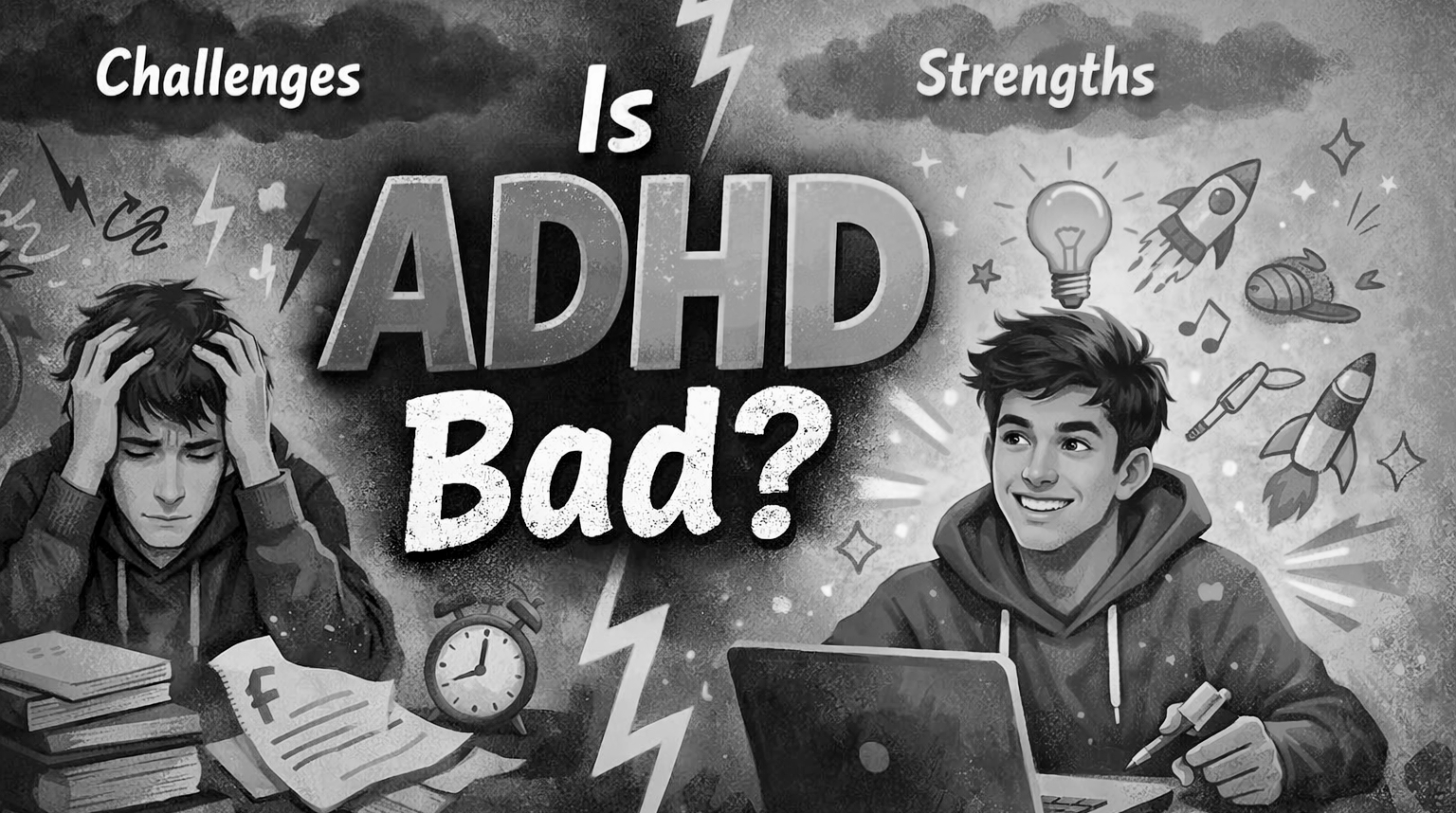
Is ADHD Bad? The Honest Truth No One Really Explains
Have you watched people stay organized, sit still, and follow through effortlessly, while your mind feels like it’s running in several directions at once?
You could have caught yourself thinking and wondering, “Wait….is something wrong with me?” Is this a problem? Or is it just who I am?
Well, you’re not alone!
When most people hear about Attention-Deficit/Hyperactivity Disorder, they immediately label it as something negative.
They see it as a flaw, a weakness, or a disadvantage.
But the truth? It’s not that simple!
In this article, you will find the answer to the question: Is ADHD Bad?
What ADHD Really Is (Not What People Think)
ADHD isn’t simply about “being distracted” or “too hyper.”
That’s the surface-level explanation people throw around, but it barely scratches the core truth.
Attention-Deficit/Hyperactivity Disorder is really about how a person’s brain regulates energy, emotions, attention, and impulses, according to the National Institute of Mental Health.
Did you pay attention to the word: regulates? You should!
And this is because the issue isn’t that you don’t have focus.
It’s that your brain struggles to control where, when, and how that focus shows up.
So, below are what ADHD really is:
1. It’s Not a Lack of Focus, It’s Unpredictable Focus
One of the biggest misconceptions of ADHD is that people with ADHD “can’t focus.”
But that’s not true.
If anything, you might have too much focus—just not on demand.
Your attention works more like a spotlight with a mind of its own.
Sometimes it refuses to turn on when you need it. Other times, it locks onto something and won’t turn off.
That’s why motivation often feels tied to interest, urgency, or emotional stimulation.
If something feels boring, repetitive, or meaningless to you, your brain resists it hard.
Not because you’re lazy.
But because your brain isn’t getting the stimulation it needs to engage.
2. The “Off Days” Feel Like Fighting Your Own Mind
Some days, it genuinely feels like your brain is working against you.
You sit down to do something important, and suddenly your thoughts scatter in different directions, you reread the same sentence five times, you forget what you were about to do, and you start a task then abandon it halfway.
Even simple things feel harder than they should be.
And the frustrating part? You know what needs to be done.
You just can’t seem to do it.
That gap between intention and action is one of the most exhausting parts of ADHD.
3. The “On Days” Feel Like a Superpower
Then, without warning, everything flips.
You find something interesting, and suddenly you’re fully locked in, time disappears, distractions fade into the background, and you’re working faster and deeper than usual.
Hours can pass, and you don’t even notice.
You might skip meals, ignore messages, or lose track of your surroundings entirely.
That intense, almost tunnel-like focus? It’s called hyperfocus!
And it’s one of the most misunderstood parts of ADHD.
People assume ADHD always means less focus.
But in reality, it can also mean extreme, sustained focus, just not always directed at the “right” things.
You can feel the confusion here because from the outside, you are seen as someone who is unreliable and inconsistent. One day, you’re highly productive and the next day, you can barely get started.
You folks might think: “You did it before, so why can’t you just do it again?”
But internally, it doesn’t feel like a choice.
It feels like your brain is switching modes without asking you.
4. It’s Also About More Than Focus
ADHD doesn’t just affect attention.
It can also impact:
I. Emotions
- Feeling things more intensely
- Getting overwhelmed quickly
- Struggling to “cool down” once upset
II. Impulses
- Speaking or acting before thinking
- Making quick decisions you will later question
III. Energy levels
- Periods of restlessness or mental fatigue
- Feeling either “all on” or completely drained
So it’s not just about being distracted.
It’s about how your entire internal system responds to the world around you.
So no, ADHD is not a lack of ABILITY. It’s not that you’re incapable.
It’s that your ability shows up inconsistently, unpredictably, and often outside of traditional expectations.
And once you understand that.
You stop asking, “What’s wrong with me?”
Is ADHD Bad?
No, ADHD isn’t bad. But it’s also not easy.
That’s the part most people don’t say out loud.
ADHD isn’t something you can neatly label as “good” or “bad.”
It depends on where you are, what you’re doing, and what’s expected of you.
Attention-Deficit/Hyperactivity Disorder isn’t a flaw in your character.
It’s a difference in how your brain is wired.
But here’s where things get complicated:
The world is designed around a very specific type of brain.
One that focuses consistently, follows routines easily, and handles repetition without much resistance.
If your brain doesn’t naturally operate that way, you’re going to feel like you’re constantly out of synchronization.
It’s not because you’re incapable. But it’s because the system wasn’t built with you in mind.
The Real Issue Is Mismatch, Not Failure
A better way to understand ADHD is to see it not as a personal failure.
It’s a mismatch between your wiring and your environment.
Think of it like trying to run high-performance software on the wrong operating system.
The software isn’t bad. The system isn’t broken.
They just wouldn’t work well together.
Put someone with ADHD in a rigid, repetitive system where tasks feel boring or meaningless, little flexibility, and success depends on long, steady focus
What will you likely see? Procrastination, mental exhaustion, missed expectations, and self-doubt creeping in
Over time, that can turn into a quiet belief of: “Maybe I’m just not good enough.”
Now take that same person and place them in a different environment—one that has variety and movement, creative problem-solving, fast-paced or high-stimulation tasks, and freedom to approach things their own way
Suddenly, everything changes.
You might see high energy and engagement, original ideas and creative thinking, deep focus on meaningful tasks, and strong, noticeable performance.
The same brain with different settings, will result in a completely different outcome!
Why This Gets Misunderstood
From the outside, people often judge based on results.
If you struggle in school or structured work, they assume something is wrong with you.
But they don’t always see the full picture.
They don’t see how hard you’re trying internally, how much energy it takes to stay on track, and how quickly you can excel when something actually clicks.
So the narrative becomes: “You’re inconsistent.”
When the reality is: “You’re in environments that don’t match how you function best.”
Staying too long in systems that don’t suit you will start to affect more than just productivity.
It affects how you see yourself. You may start to:
- Question your intelligence
- Doubt your potential
- Compare yourself unfairly to others
And that’s where ADHD can feel bad.
Not because of what it is.
But because of how it’s experienced over time in the wrong conditions.
The Real Difference
So no, ADHD isn’t inherently bad.
But it can feel bad when:
- You don’t understand it
- You’re constantly forced into environments that drain you
- You measure yourself by standards that don’t reflect how you work best
The difference isn’t the person.
It’s the fit.
And once that fit changes—even slightly—everything else can start to change with it too.
The Part Nobody Talks About: ADHD Strengths
When people talk about Attention-Deficit/Hyperactivity Disorder, the conversation usually stops at the struggles.
The missed deadlines, the distractions, and the inconsistency.
But that’s only half the story.
Because ADHD doesn’t just come with challenges.
It also comes with real, powerful advantages.
The kind that, when understood and used well, can set you apart.
1. Your Brain Is Built to Connect Dots Fast
People with ADHD don’t just think in straight lines.
Your brain moves sideways, diagonally, and sometimes in completely unexpected directions.
You see patterns others miss, make connections between unrelated ideas, and come up with solutions that aren’t “obvious.”
While others follow a structured path, your mind explores.
That’s where originality comes from.
You don’t just process information—you reimagine it.
And in fields like writing, business, design, marketing, and problem-solving?
That kind of thinking is a serious advantage.
2. Intensity That Can Become Power
ADHD often comes with bursts of energy—mental, emotional, or physical.
Unchanneled, it can feel like restlessness. But directed properly?
It becomes a drive. It becomes momentum.
It becomes the ability to work intensely for periods of time, dive into projects with full force, and push ideas forward faster than others.
The key difference is direction.
Without it, the energy feels chaotic. With it, the energy becomes productive.
You can check these Neurodivergent Music for ADHD to inspire you to explore your power.
3. Deep Work on Another Level
This is one of the most misunderstood strengths.
When something genuinely captures your interest, you wouldn’t just focus.
You lock in.
You can spend hours refining a single idea, learn something deeply in a short time, and produce high-quality work without noticing time passing.
This state—often called hyperfocus—is something many people struggle to access.
But for you, it’s natural under the right conditions. The challenge isn’t having it.
It’s learning how to trigger and direct it toward what matters.
4. You Move When Others Hesitate
People with ADHD are often more willing to act.
Not because they don’t think.
However, it’s because they’re less likely to overthink themselves into inaction.
You’re more open to trying new ideas, starting before everything feels “perfect,” and taking chances others avoid.
That willingness to move, even when things are uncertain, is what creates opportunities.
While others are stuck analyzing, you’re already experimenting.
And in many areas of life, speed and courage matter just as much as precision.
5. Thinking on Your Feet
Another quiet strength?
You adapt quickly!
Because your brain is used to switching, adjusting, and recalibrating, you can often handle unexpected changes better, pivot when things don’t go as planned, find alternative paths without getting stuck
What feels like “scattered thinking” in one context can become flexibility and resilience in another.
The Real Advantage Isn’t the Traits—It’s the Combination
Each of these strengths is powerful on its own.
But together? They create something rare.
Creativity + energy equals ideas that actually get executed
Hyperfocus + curiosity equals deep expertise in areas you care about
Risk-taking + adaptability equals faster growth through action
That combination isn’t common.
And it’s often the reason why people with ADHD, once they figure themselves out, can move in ways others can’t.
These strengths don’t always show up in traditional systems.
This is because schools reward consistency and jobs reward predictability.
So if your strengths show up as bursts instead of steady output, they can be misunderstood or completely missed.
That’s why many people with ADHD grow up thinking they only have weaknesses.
When in reality, their strengths just weren’t being measured properly.
Many highly capable, successful people think this way.
They’re not “better.”
They just learned something crucial: Instead of fighting how their brain works, they built it around it.
And that’s the shift.
Because once you stop seeing ADHD as something to suppress.
And start seeing it as something to understand and direct, those “random traits” start to look a lot more like advantages.
When ADHD Becomes a Real Problem
Let’s not sugarcoat it.
Attention-Deficit/Hyperactivity Disorder can become a serious struggle, but not for the reasons most people think.
It’s not just about distraction. It’s not just about “not focusing enough.”
The real problem starts when there’s a disconnect between how your brain works and how you’re trying to live your life.
1. It Starts With Not Understanding Yourself
If you don’t understand how your brain operates, everything feels confusing.
You might ask yourself:
- “Why can I do this sometimes, but not all the time?”
- “Why do simple things feel so hard?”
- “Why can’t I just be consistent like everyone else?”
Without answers, it’s easy to land on the wrong conclusion that “something must be wrong with me.”
That misunderstanding is where the struggle begins.
Because when you misinterpret your own behavior, you start responding to it in ways that make things worse.
2. The Trap of Constant Comparison
Then comes comparison.
You look at people who stay organized without trying, follow routines easily, and finish tasks on time, consistently.
And you measure yourself against that standard.
But here’s the problem: You’re comparing your behind-the-scenes struggle
to someone else’s natural wiring.
That gap can make you feel like you’re always falling short, even when you’re putting in more effort than most people realize.
Over time, that turns into frustration, self-doubt, and quiet shame
Not because you lack ability.
But because you’re using the wrong measuring stick.
3. Forcing Yourself Into the Wrong Systems
This is where things often get worse.
Instead of adjusting the system, you try to force yourself to fit it.
You tell yourself things like: “I just need more discipline, ” “I need to try harder,” and “I need to be like everyone else.”
As a result, you will overcommit to rigid schedules, push through tasks that drain you, and ignore how your brain actually functions.
And for a while, it might even seem like it’s working.
Until it doesn’t.
Because forcing yourself to operate in a way that doesn’t match your wiring isn’t sustainable.
Eventually, you will burn out.
4. What It Turns Into Over Time
When this cycle repeats, ADHD doesn’t just stay a productivity issue.
It starts affecting how you feel about yourself.
You may experience constant stress, always trying to catch up, keep up, or stay on track, and it feels like you’re one step behind.
You will also begin to question your intelligence, your discipline, even your potential.
In addition, you will feel stuck, you want to move forward, but it feels like something invisible keeps holding you back.
And one of the hardest parts? You might start believing this is just who you are!
5. Internal Pressure
A lot of the struggle isn’t even external.
It’s internal.
You will experience the pressure to “do better,” the guilt of unfinished tasks, and the frustration of knowing what to do—but not doing it.
That mental weight builds up over time.
And it can make even small tasks feel overwhelming!
Check these 50 tips for adults with ADHD to take charge.
The Shift That Changes Everything
The moment things start to improve isn’t when you “fix” yourself.
It’s when you start asking:
“What actually works for me?”
Because when you begin to understand your patterns, your energy, and your triggers, you stop fighting your brain and start working with it.
And that’s when ADHD stops feeling like a constant problem and starts becoming something you can actually manage and grow with.
Keep in mind that ADHD isn’t a flaw.
It’s a different operating system.
And like any system, it has strengths and limitations.
If you treat it like a weakness, you’ll constantly feel like you’re falling behind.
But if you learn how it works—and start building your life around it instead of against it—you unlock something powerful.
Final Thoughts
So, is ADHD Bad or Good?
It’s neither. It’s neutral!
What matters is:
- How well you understand it
- How you structure your environment
- And how you choose to work with it
With the right habits, awareness, and support, ADHD can shift from something that feels like a burden to something that actually gives you an edge!
Trust

Welcome! I’m Trust. I’m a writer, public instructor, and mobile photographer. I’m passionate about an organized and productive life and have keen concern for folks living with ADHD and those having a slow processing speed. Join me on this journey as we live an organized and productive life!